
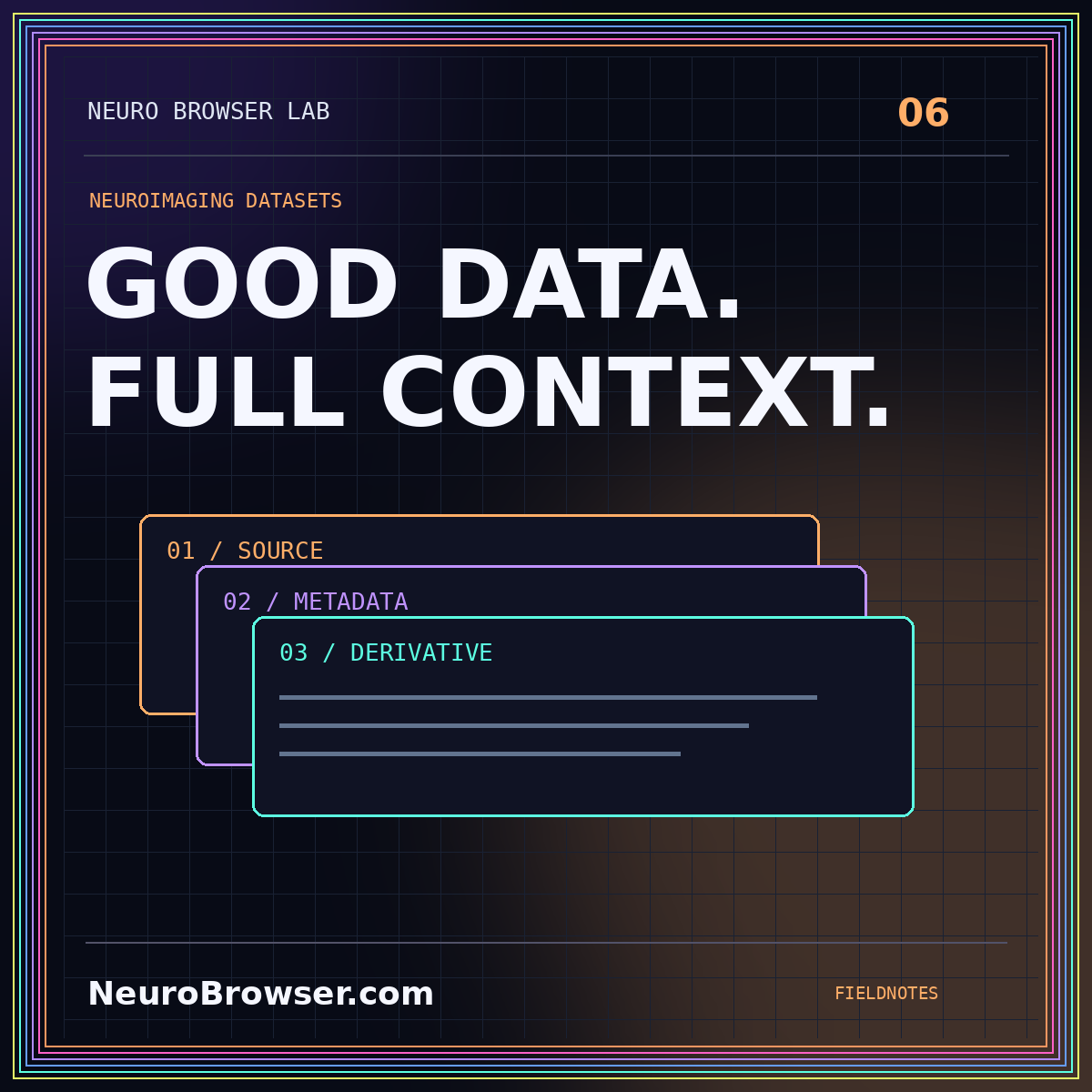
A folder can be tidy while the research inside it remains difficult to understand. Files may have consistent names but no clear acquisition context, several derivative versions may be mixed together, and a reviewer may not know which records belong to the same participant or session. Neuroimaging dataset organization should preserve the meaning around the files, not simply make the directory look orderly.
This guide proposes a first-pass dataset review for researchers and developers learning the field. It does not supply a dataset, validate a collection, or authorize access to participant information. Work with an appropriate educational example while learning the structure, and keep scientific interpretation and data-use approval with the people responsible for them.
Begin with the research purpose and access boundary
Write the question the dataset was collected to investigate and the question you hope to ask of it. Those may not be the same. Record the original collection context, the available documentation, and what you do not yet know. A dataset that is well described can still be unsuitable for a new purpose, so keep organizational quality separate from scientific fitness.
Identify who controls access and which conditions govern reuse before copying material into a new environment. Do not assume that an accessible archive permits unrestricted redistribution or model training. Keep permission questions in the review note and direct them to the relevant steward. A technically convenient workflow should not silently redefine the authorized use of the collection.
Inventory what is actually present
Create a small inventory of file types, source identifiers, and relationships between records. Distinguish original acquisitions, descriptive metadata, processing outputs, and figures prepared for presentation. Avoid interpreting a preview image as the underlying research record. The inventory should explain what each class of material is for and where the supporting description can be found.
Record missing material explicitly. A directory may contain image files but omit information needed to understand how they were acquired or processed. Do not fill those gaps by copying values from a similar-looking file. An honest inventory is useful partly because it identifies questions that must be resolved before the dataset can support the proposed analysis.
Learn the organizing vocabulary before renaming files
The Brain Imaging Data Structure, or BIDS, provides a standardized approach to describing and organizing neuroimaging-related research data. Its specification distinguishes shared principles, modality-specific material, and derivatives. Use the applicable documentation to learn the vocabulary before changing a collection. A filename that looks familiar is not proof that the full dataset follows the relevant specification.
Start with a small educational example and trace a few files through their descriptions. Identify the participant, session where applicable, acquisition context, and accompanying metadata. Keep a record of which specification version you are consulting. Avoid presenting a casual manual review as formal validation; structure, completeness, and scientific interpretation are different tasks.
Keep identifiers meaningful without exposing identity
Decide which identifiers belong in the working dataset and which must remain in a restricted mapping held by the responsible team. Do not add names or other direct identifiers to public notes for convenience. Ask how participant-linked information should be handled under the collection’s actual approvals and procedures. This guide is not a de-identification checklist or a statement of legal compliance.
Make relationships understandable without relying on personal details. A reviewer should be able to tell which sessions or acquisitions belong together using the approved study identifiers. Preserve those relationships when preparing a subset. Changing identifiers without documenting the mapping can make a collection harder to review even when the change was intended to simplify it.
Preserve raw material and record derivatives separately
Keep original material distinguishable from outputs created by processing. Record the workflow, relevant parameters, software identifiers, and input versions associated with each derivative. The goal is not to reproduce every technical detail in a human-facing summary. It is to give a reviewer a reliable route from a result back to the material and process that produced it.
Write a derivative note a colleague can follow
Choose one processed output and describe its origin in a short note. Identify the source record, the transformation, the purpose, and any unresolved limitations. Ask another person to locate the same input and output using only that note. Difficulty in this exercise often reveals missing identifiers or undocumented assumptions before they spread through a larger workflow.
Keep metadata attached to the questions it answers
A metadata file is useful when someone understands what its fields mean and how they apply to the data. Build a small data dictionary for the fields your intended analysis needs. Record units and conventions where they matter, and do not treat an empty field as equivalent to a meaningful zero. Keep unknown, missing, and not-applicable states distinct when the collection allows that distinction.
Review whether the metadata supports the comparisons you intend to make. If acquisition conditions differ, preserve those differences in the analysis plan instead of hiding them in a uniformly named directory. The neuroimaging topic introduces these context questions, while the data science guide connects them to the unit of analysis.
Plan subsets and evaluation groups carefully
Before creating a teaching subset or an evaluation collection, identify the related records that need to stay together. A participant, a session, and a derived image are not interchangeable units. Write the grouping rule before selecting examples. Keep the selection process and exclusions documented so that another reviewer can understand what the subset does and does not represent.
Avoid calling a convenient subset representative without evidence. A small collection may be useful for learning file structure or testing a pipeline while saying little about broader scientific performance. Give it a purpose-specific description. Clear labels such as “format exercise” or “pipeline smoke test” are more informative than an unsupported claim of general validation.
Treat technical checks as one layer of review
A technical validator can help identify structural issues within the scope of its rules, but it should not be treated as a scientific or privacy approval. Record the tool and version, the checks performed, and unresolved findings. Separate an error that blocks use from a warning that needs interpretation by someone familiar with the collection and intended workflow.
Review the output rather than simply saving a pass message. Ask what was not checked and which questions still require a data steward or domain specialist. Our AI datasets topic uses this distinction to separate a navigable archive from an appropriate dataset for a specific question. Organization is necessary context, not a guarantee of suitability.
Prepare a handoff that preserves limitations
A handoff should include the purpose, access boundary, inventory, identifiers, applicable conventions, processing history, and known gaps. Add a small worked example showing how a source file relates to its metadata and derivative. Keep the explanation readable enough for someone joining the project without having attended the original planning discussions.
Identify the owner of unresolved questions and explain what should not be done until they are answered. Avoid relying on an undocumented conversation for decisions about reuse or interpretation. A dataset handoff is more reliable when the limits travel with the files rather than remaining in the memory of the person who prepared the archive.
Conclusion: organize the evidence around the files
Good dataset organization gives future readers a way to understand what exists, why it was collected, how it changed, and what remains uncertain. Start with a small inventory and an explicit access boundary. Preserve relationships between records, original material, metadata, and derivatives. Expand the workflow only after another person can trace a representative example without guessing.
The supporting reference is the BIDS specification introduction, which explains the motivation and structure behind this approach to research data. Consult the applicable modality and version for real work. The review method above is an educational starting point, not a declaration that a dataset is compliant, de-identified, or clinically interpretable.