
Useful agents. Clear boundaries.
Define a browser agent’s authority, action gates, and stop conditions before allowing it into a research workflow.

Explore the intersection of AI, the browser, and brain science. Clear guides for curious minds. Practical ideas for researchers and builders.
NeuroBrowser.com connects the questions behind neural browsing: how models use information, how visual data becomes a label, and how to read brain-related research without losing its context. Choose a topic, follow the evidence, and build your own informed perspective.
What is Neuro Browser?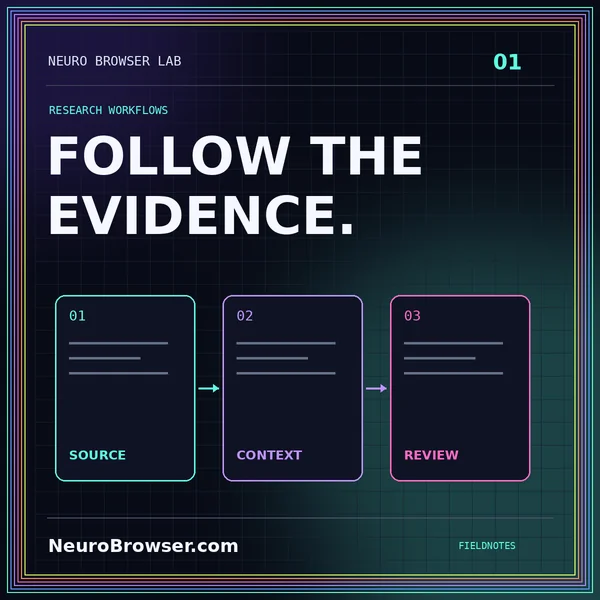
Start with the browser you already use. Explore source-first reading, extension permissions, and practical differences across desktop and mobile environments.
Read the field guide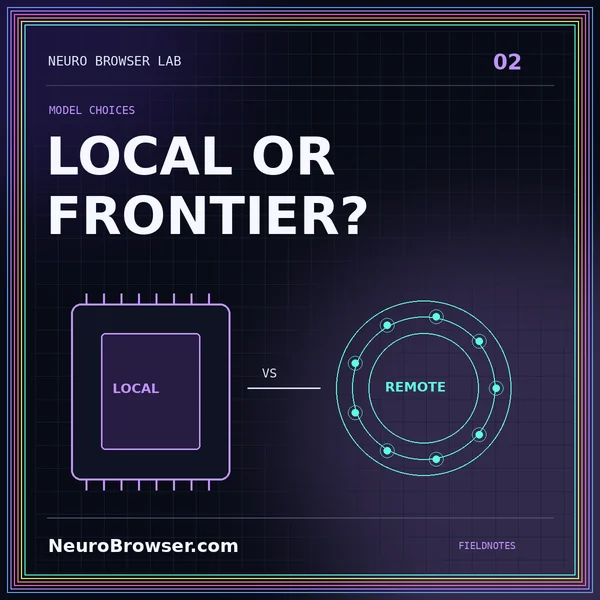
Separate language models from agents, prompts from permissions, and local inference from remote services. Build a useful mental model before choosing a tool.
Read the field guide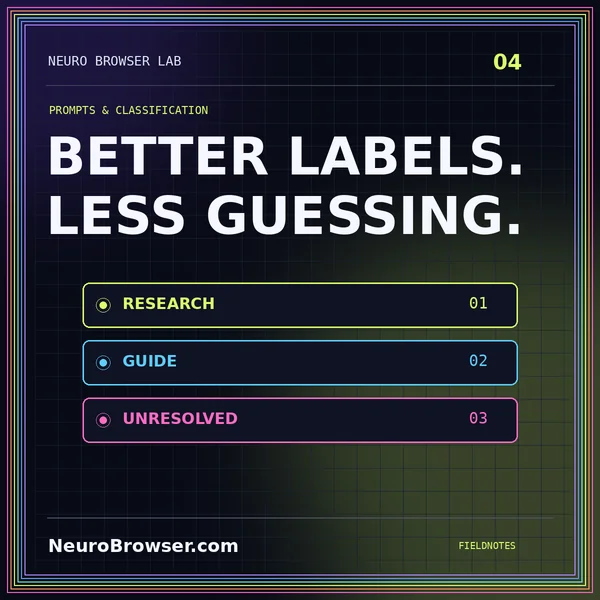
Good decisions begin with explicit labels, traceable datasets, and understandable contracts. These guides turn broad AI ideas into reviewable workflows.
Read the field guide
Explore photos, video, image processing, and classification with attention to context, evaluation, and the original evidence behind every visual result.
Read the field guide
Read clear introductions to neuroimaging, brain scans, and cognitive-health information. Research literacy matters; an image or model output is not a diagnosis.
Read the field guide
Navigate brain–computer interfaces, wearable signals, neuromorphic ideas, and pharmaceutical imagery without confusing research concepts with available products.
Read the field guideGo beyond the headline with practical methods, careful comparisons, and context that travels with the evidence.
Define a browser agent’s authority, action gates, and stop conditions before allowing it into a research workflow.
Review extension access, page context, remote processing, updates, and removal using a contained, non-sensitive test.
Understand BCI research through its measurement, decoding, feedback, and user-control loop—not a promise of mind reading.
Original guides for research practice, not personal medical interpretation or product certification.
Know what you are exploring—and what the evidence does not claim.
No. NeuroBrowser.com is an educational website about AI-assisted browsing, visual data, and neural research. It does not distribute a browser, extension, native app, or BCI device.
Begin with the Neuro Browser introduction for a source-first research workflow. Developers can start with AI API concepts; readers interested in brain science can begin with brain-scan literacy and BCI research.
No. The AI, LLM, API, and dataset pages are learning resources. This website does not execute inference, issue API keys, maintain live dataset catalogs, or accept data uploads.
No. Brain and imaging articles explain terminology and research context. They do not interpret personal images, assess cognitive ability, or diagnose conditions. Discuss personal health concerns with a qualified clinician.
Use the RSS link in the footer to follow the Lab and topic guides in a feed reader. No account or email signup is required. You can also browse the category and tag reading paths in the Lab.
Have a source to suggest, a correction to share, or a topic you would like to see explained? Let’s keep the conversation thoughtful.